

From Combat to Capitol Hill: A Veteran's Warning on Tulsi Gabbard
How my journey through trauma, advocacy, and leadership shaped my view of Gabbard's threat to national security

What I Learned About Leadership (and Failure) from Tulsi Gabbard
Let’s talk about my old acquaintance, Tulsi Gabbard—a person who I believe should absolutely not be confirmed as the next Director of National Intelligence. And I don’t say this lightly. I’ve worked with her, I know her, and I owe her a lot both personally and professionally. But as someone who cares deeply about the future of this country, I need to be honest about who Tulsi Gabbard really is.
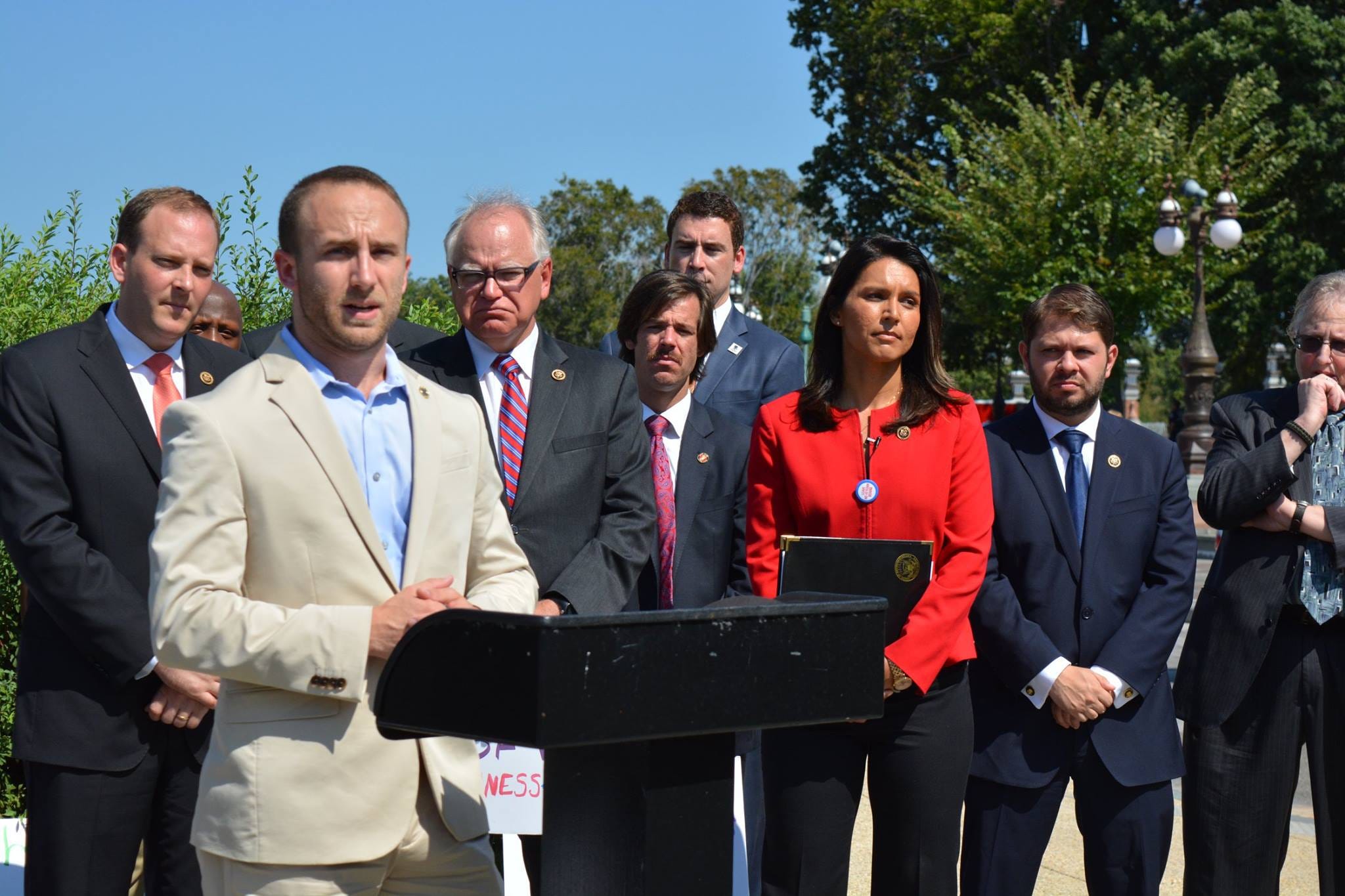
The photo above is from back in 2016 (before I adopted the beard) when I was a professional veterans advocate working on Capitol Hill to pass bipartisan legislation to support our nation’s veterans. In that role, I worked with Republican and Democratic lawmakers alike. That snapshot is of me speaking at a press conference that I organized with people like now-Governor Tim Walz, now-Senator Ruben Gallego, and now-EPA Administrator Lee Zeldin—all veterans—when we were pushing for the Fairness for Veterans Act. Tulsi Gabbard, also a Post-9/11 era veteran in Congress at the time, was there too as an original cosponsor of the Fairness for Veterans Act. But while I got to know many leaders on both sides of the aisle, my time working with Tulsi was... revealing in ways that should concern everyone.
I met Tulsi in January 2014, a year after she had first arrived in Congress. Though I had previously marched through the halls of Capitol Hill with an antiwar veterans group, I was just beginning to understand how to work effectively with lawmakers. At that time, I didn’t care much about politicians or parties and focused solely on policies that affected veterans.
Around that same time, I was undergoing a personal transformation. I had recently begun attending Nassau Community College, a step that changed my life profoundly. Back in 2005, I had been a 19-year-old patrolling the streets of Sadr City, Baghdad, after enlisting in the Army in the wake of 9/11. The experiences I had in Iraq left me with both strengths and scars—leadership experience and maturity, but also PTSD and other challenges.
Following a suicide attempt brought on by my PTSD, I was discharged from the Army with bad-paper—a type of discharge that renders veterans ineligible for key benefits like the GI Bill and even VA healthcare. This lack of support often leaves veterans struggling to reintegrate into civilian life, denied access to the very education, employment, and medical care benefits necessary to facilitate a successful transition. After years of recovery and the support of a great medical team at the VA, I finally found my way back on my feet. At Nassau, I discovered a community of other veterans and a renewed sense of purpose, becoming president of Student Veterans of Nassau. My mentor, a former senior congressional staffer, guided me toward a career in advocacy, where I learned how to lobby for veterans like myself who had been left behind by the system.
My experiences in education and advocacy gave me the skills to navigate Capitol Hill—and they also taught me what real leadership looks like. I came to value traits such as consistency, transparency, empathy, and the ability to inspire and build trust. Real leaders stand by their principles and support their teams, fostering an environment where people feel empowered to succeed. These traits contrasted sharply with the behavior I observed from Tulsi Gabbard, whose erratic decisions and lack of integrity created chaos and demoralization among her staff.
Tulsi was among the first veterans in Congress who would listen to my story with empathy, and ultimately support the legislation that I was proposing to help veterans who had been unfairly discharged because of untreated symptoms of service-related conditions such as PTSD, traumatic brain injury, or military sexual trauma. She was a Post-9/11 veteran in congress who was openly critical of the wars we had been in, and here she was standing up for me, a former soldier who after surviving a suicide attempt had been further traumatized by the loss of identity and community that came with my less-than-honorable discharge.
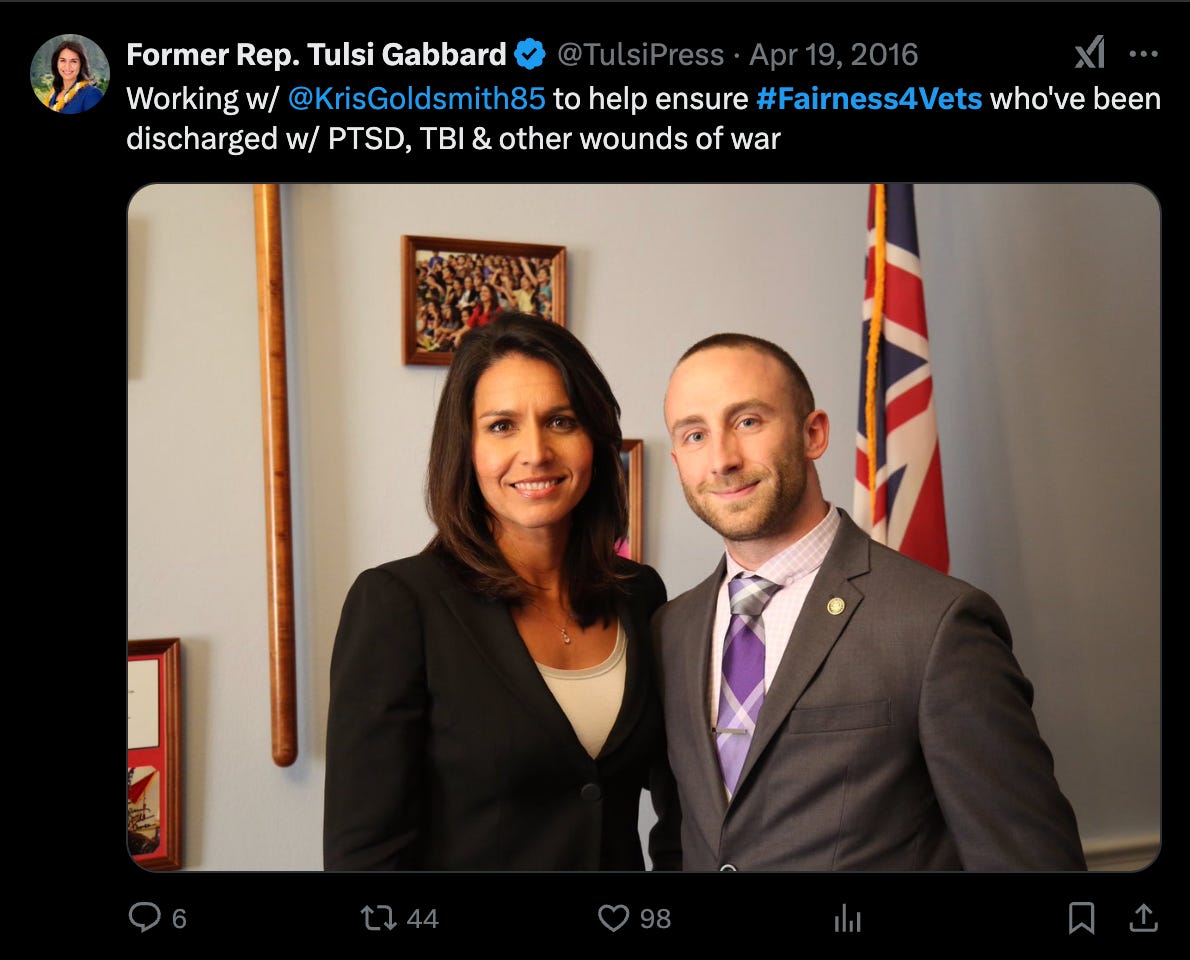
As a result of my discharge characterization I had been largely ostracized by the veterans community—at least at first. As of 2007, I wasn't eligible to join most of the well known veterans service organizations like American Legion or Veterans of Foreign Wars. Student Veterans of America, a small organization at the time had been the only mainstream veterans organization to welcome me into a leadership position by the time I met Tulsi. So her giving me a chance really meant a lot to me.
I explain all of this because I want you, my readers, to understand that I once had tremendous respect for Tulsi. But as meaningful and as important as her support for me was in that critical moment in my life both personally and professionally—it doesn't outweigh the threat that I believe she poses to the United States today.
Behind the Scenes: A Look at Gabbard’s Leadership
By the time these photos from 2016 were taken, it was well known that Tulsi’s office had by far the highest staff turnover rate on Capitol Hill. Why? There are two main reasons, and they paint a picture of someone utterly unfit for leadership—especially over something as crucial as our national intelligence apparatus.
First, Tulsi had no consistent moral or ethical framework to guide her decisions. Like Donald Trump—the fascist she now idolizes—she had no core policy beliefs. This made her office a chaotic nightmare for her staff. For example, Tulsi would tell her policy and communications teams that she planned to vote a certain way on a bill. Her staff would prepare press releases, tweets, and statements accordingly. Then, without warning, she’d do the exact opposite of what she’d just told them, blindsiding them and undermining their work.
Imagine being her staffer, looking up at the TV to see her contradicting everything you’d just announced to the public. It wasn’t a one-time thing; this unpredictability was constant.
Second, she was demoralizing to her team. Veterans who worked for her—and there were many—found themselves treated with disrespect and disregard. I’ve seen firsthand how Tulsi’s erratic leadership and disdain for her own staff made it impossible for anyone to trust or follow her. And this wasn’t just an internal issue. It affected her constituents and the legislation she was supposed to champion.
In hindsight, I look at the nearly eight years that I worked with Tulsi Gabbard and her office and realize that she is a lot like I was during the darker periods of my life. Before my turning point, after coming home from Iraq traumatized and realizing that the war I fought in had been based on lies, I felt deeply disillusioned. I was, I must admit, extremely vulnerable to manipulation. That "big lie" that sent me to war, that led to so many of my friends (and even family) getting sick, injured, or killed—it made me question everything.
I began to believe that any idea from a powerful institution must be a lie. For a while I was pretty easily adopting conspiracy theories as truth, because after they lied to get me and my friends to experience and take part in the horrors of war—why wouldn't they lie about everything less important?
Now, to be clear—I am not saying that I believe Tulsi has survived some sort of trauma that involved being lied to, or that people with trauma become conspiracy theorists. But what I am saying is that it's my personal experience going down those rabbit holes myself—not just my experience studying and fighting against disinformation and radicalization—that makes me see these same patterns in Tulsi's thinking and actions. She's not a heterodox thinker informed by her unique education or experiences—she's a conspiracy theorist who can't help but be this way because something about the way she perceives the world is fundamentally broken.
National Security at Risk
Tulsi’s behavior might seem like "office drama" on Capitol Hill, but let’s consider the stakes. Intelligence agencies rely on trust, sacrifice, and precision. People working in intelligence often risk their lives—and we have assets all over the world who are loyal to the United States, sometimes at great personal cost.
Now imagine someone like Tulsi Gabbard, who has shown a willingness to side with authoritarian regimes, leading these agencies. Her erratic, toxic leadership would cripple morale and effectiveness, making it impossible for intelligence officers to do their jobs.
During her recent confirmation hearing, Gabbard faced bipartisan scrutiny, with key concerns centered on her meetings with Syrian President Bashar al-Assad and her controversial refusal to label Edward Snowden a traitor. Senators questioned her judgment, expressing doubts about her loyalty to U.S. allies and the consistency of her national security positions. While she emphasized her commitment to national security, her erratic behavior and troubling alliances remained focal points of contention.
Despite this, her nomination advanced through the Senate Intelligence Committee by a narrow 9-8 vote along party lines. Key Republican senators, including Susan Collins and Todd Young, expressed initial hesitance before ultimately supporting her nomination after private assurances. However, skepticism about her judgment persists, with senators and intelligence officials warning that her leadership style could have disastrous consequences for national security.
That’s why, despite my professional history with Tulsi, I feel a patriotic duty to speak out.
Take Action: Make Your Voice Heard
You don’t have to be personally connected to people like Tulsi Gabbard to make a difference. Given the risks posed by her leadership to national security and public trust, it’s vital for citizens to take action and hold their representatives accountable. Our democracy gives you the power to hold your leaders accountable. Here’s how you can act right now:
Visit this page on 5Calls.org which will help you find your two U.S. senators and their contact information and provide you additional background information on this issue.
Call both offices. The 5 Calls page provides a very brief script that you can use.
Leave a comment below to let folks know who you called, and how your calls went.
These calls matter. Senators listen to their constituents, and your voice has power. Whether your senators are from the same political party as you or not, they still represent you, and your opinion is crucial in a functioning democracy.
This is how we protect our nation—not by staying silent, but by speaking up and demanding accountability from those who lead us. Let's make sure Tulsi Gabbard never comes close to leading our intelligence community.
Excellent piece from someone with first hand information. Clear and compelling information and call to action. Thank you.
I messaged my Senators Alex Padilla (D-CA) & Adam Schiff (D-CA). I don’t know if I will receive a message in response, but I just want to see them & other senate Dems fillibuster all night for the full (30) hours of debate time to block & protest Tulsi Gabbard.
Here’s my message to both of them:
Dear Senator:
I urge you to use every procedural tool available to block the confirmation of Tulsi Gabbard for Director of National Intelligence.
Fillibuster all night for the full 30 hours of debate time if necessary to prevent her from taking office.
Tulsi Gabbard’s sympathy towards Bashar al-Assad and parroting of Kremlin propaganda make her a dangerous choice to lead the U.S. Intelligence Community.
Thank you for your time and consideration.
Sincerely,
Cristina de la Fuente, BSN, RN